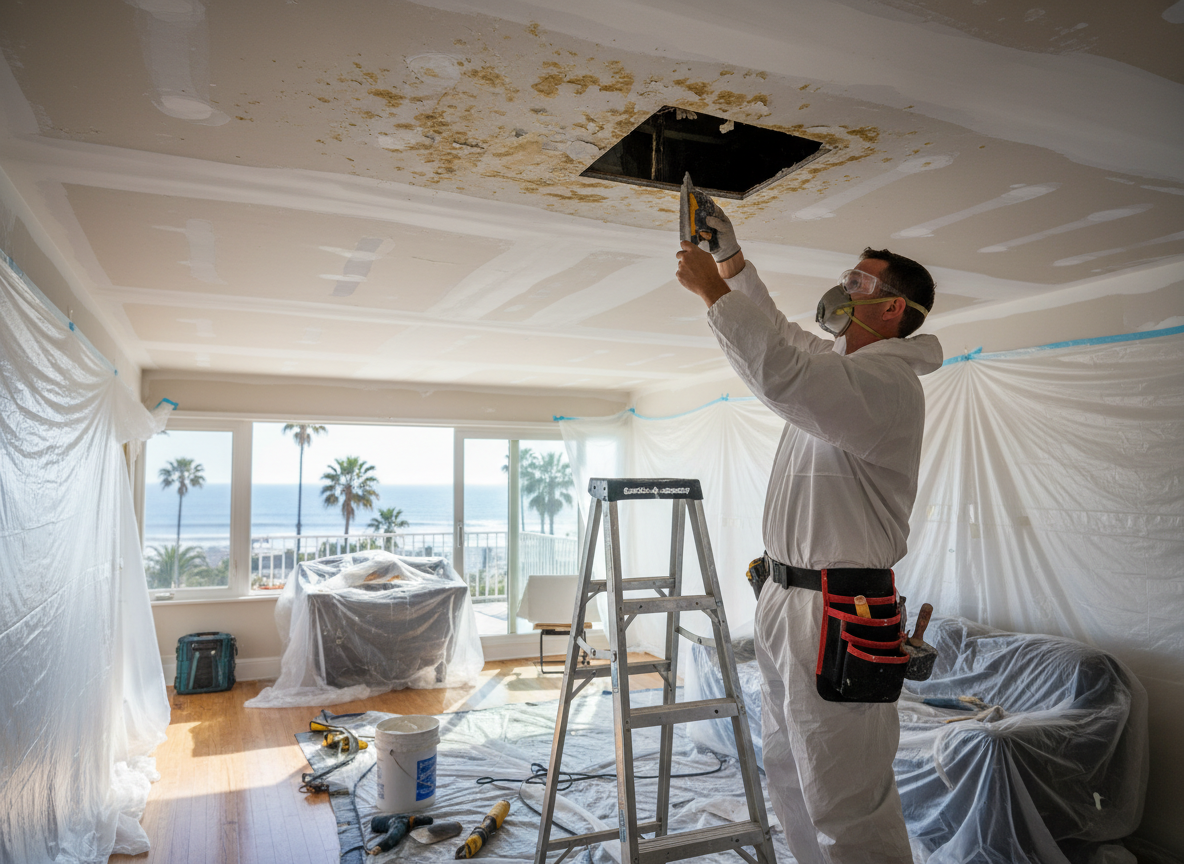
Playa Del Rey homes built from the 1950s through 1970s often feature lath-and-plaster ceilings over shallow roof cavities. Marine layer fog rolls in nightly from the Pacific, raising humidity levels inside these voids and allowing slow leaks from roof penetrations or bathroom exhaust fans to saturate drywall without obvious surface signs until staining or sagging appears. Technicians map moisture with infrared cameras because standard pin meters miss pockets trapped behind textured plaster common in Playa Del Rey Village and the Dockweiler Beach area.
Once the leak source is isolated, crews remove only the minimum ceiling section needed for airflow while protecting adjacent hardwood floors and built-in cabinetry typical of Silicon Beach properties. Dehumidifiers sized for the square footage run until readings drop below 12 percent moisture content, a threshold required before new drywall can be installed without future mold risk. In homes close to Ballona Creek, tidal influence on groundwater can push additional vapor through slab edges, requiring extra perimeter drying time not needed in inland Los Angeles neighborhoods.
Final repair includes matching the original ceiling texture and painting with mildew-resistant primer to handle the persistent coastal humidity. Owners in Marina Del Rey and Culver City often request the same process after shared-wall leaks travel between townhomes. Every job ends with a written drying log so insurance adjusters see exactly how long equipment ran and why additional demolition was required.
Technician insight
In Playa Del Rey, the thing that catches most people out with Ceiling water damage repair is marine layer fog that drives condensation into shallow roof cavities of 1960s stucco homes near Ballona Creek; the moisture travels laterally along plaster keys and shows up two rooms away from the actual leak, so skipping thermal imaging always leads to callbacks.
Hidden Leak Behind Plaster Ceiling
A homeowner in Playa Del Rey Village noticed a small brown spot after several foggy weeks. Inspection found a roof vent leak that had traveled along lath and plaster into a bedroom ceiling near Dockweiler State Beach. Crews opened a limited section, dried the cavity for four days, then repaired and textured to match the original finish.
How it works
- 1
Moisture Mapping And Source Identification
Technicians scan ceilings with thermal imaging and moisture meters to locate hidden saturation from roof leaks or condensation driven by Playa Del Rey marine layer fog.
- 2
Water Source Containment
Temporary roof tarps or plumbing isolation stops active leaks before drying begins, protecting nearby properties along Pacific Avenue and near Dockweiler State Beach.
- 3
Controlled Demolition And Drying
Affected sections are opened for airflow while industrial dehumidifiers and air movers run until drywall and framing reach safe moisture levels.
- 4
Repair And Texture Matching
New drywall is installed, taped, and finished to match original ceiling textures common in mid-century Playa Del Rey homes before final painting.
Pricing
Pricing varies by square footage affected, access difficulty in older plaster ceilings, and any hidden damage found during drying; upfront quotes provided after inspection.