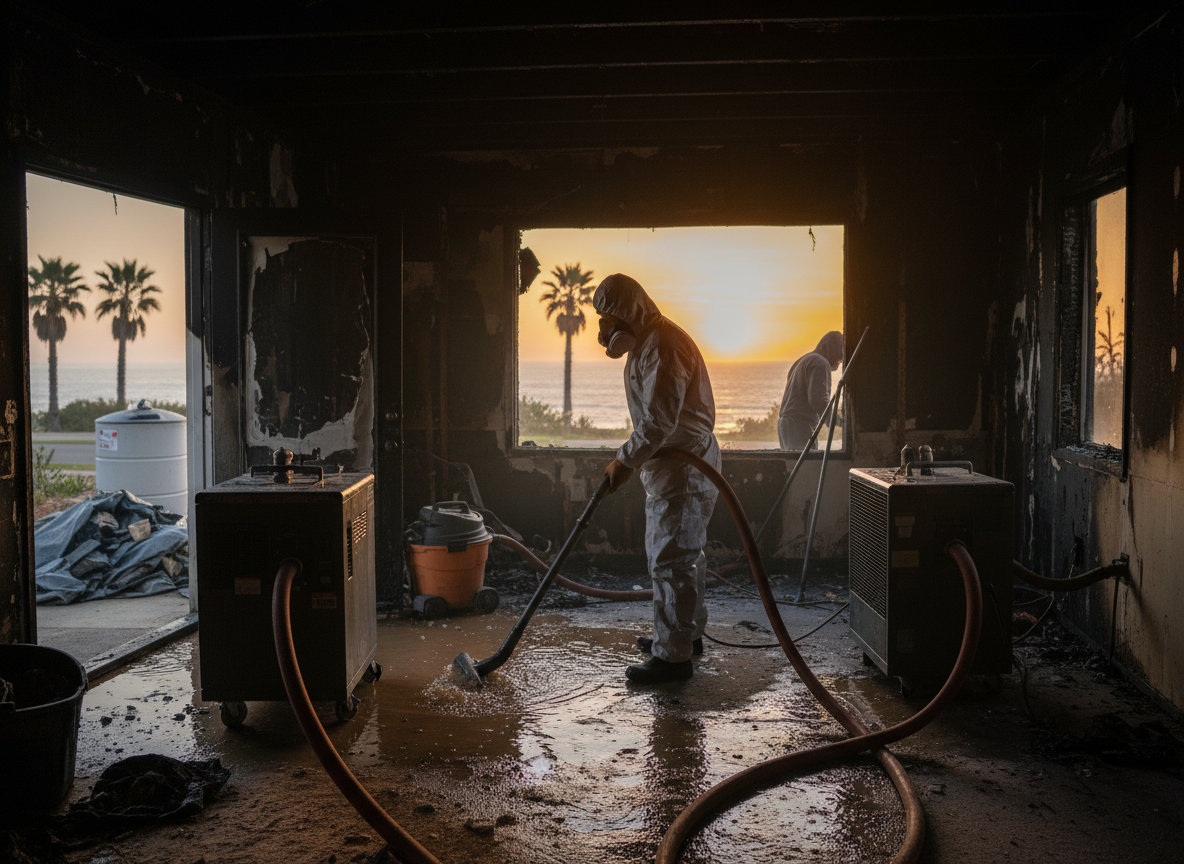
Firefighting efforts in Playa Del Rey often introduce large volumes of water into older stucco and wood-frame homes common along Pacific Avenue and near Ballona Creek. This moisture quickly migrates into wall cavities and subfloors, especially in properties built before modern vapor barriers became standard. Marine layer fog that rolls in from Dockweiler State Beach keeps relative humidity elevated for days, slowing natural evaporation and raising the risk of hidden mold growth within forty-eight hours.
Silicon Beach commercial buildings and multi-unit residences near Culver City frequently have mixed HVAC systems that can spread soot-laden water across multiple floors if not isolated early. Technicians must remove saturated insulation, treat affected framing with antimicrobial solutions, and deploy industrial dehumidifiers sized for the coastal climate rather than inland Los Angeles conditions. Failure to address water trapped behind tile in bathrooms or under floating floors near Playa Del Rey Beach leads to recurring odors and structural softening.
Local terrain slopes gently toward the creek and ocean, so water from upper-level fire suppression can travel laterally under slabs and into neighboring units. Crews use moisture meters on concrete and perform targeted demolition only where readings exceed twenty percent, preserving as much original material as possible while meeting Los Angeles County habitability requirements.
Technician insight
In Playa Del Rey, the thing that catches most people out with water damage remediation after fire is the marine layer fog that sits over Ballona Creek and Dockweiler State Beach for days. Homeowners near Pacific Avenue assume everything is dry once visible water is gone, but the constant humidity keeps subfloor moisture high long enough for hidden rot to start in the older raised-floor homes common here.
Fire-Suppression Water in Playa Del Rey Village Home
A kitchen fire in a 1960s single-story house near Playa Del Rey Village sent water under the slab and into the crawl space. We found elevated moisture readings extending fifteen feet into the living room subfloor. Extraction and targeted drying prevented mold while preserving original hardwood in unaffected rooms.
How it works
- 1
Initial Assessment
Arrive within hours, document all affected areas with meters, and identify water migration paths created by fire hoses.
- 2
Water Extraction
Remove standing water from floors and cavities using truck-mounted pumps suited to coastal humidity levels.
- 3
Drying and Monitoring
Place air movers and dehumidifiers, then check daily moisture readings until levels match unaffected areas.
- 4
Sanitization and Restoration
Apply antimicrobial treatments, remove damaged materials, and prepare surfaces for repairs.
Pricing
Cost depends on square footage affected, number of affected levels, and extent of hidden moisture; site inspection required for accurate scope.